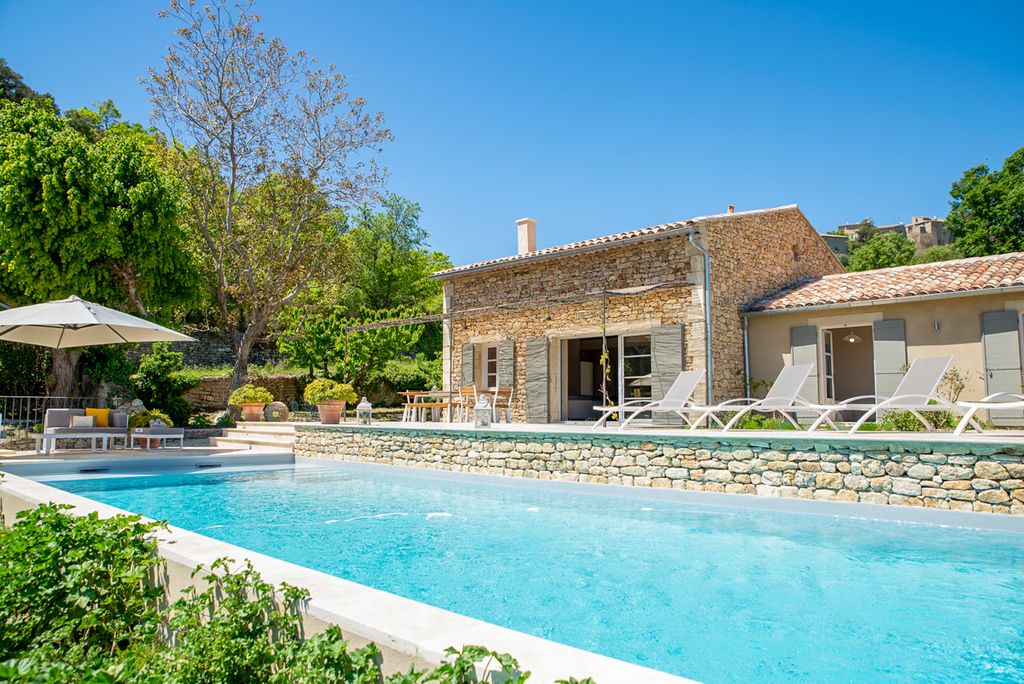
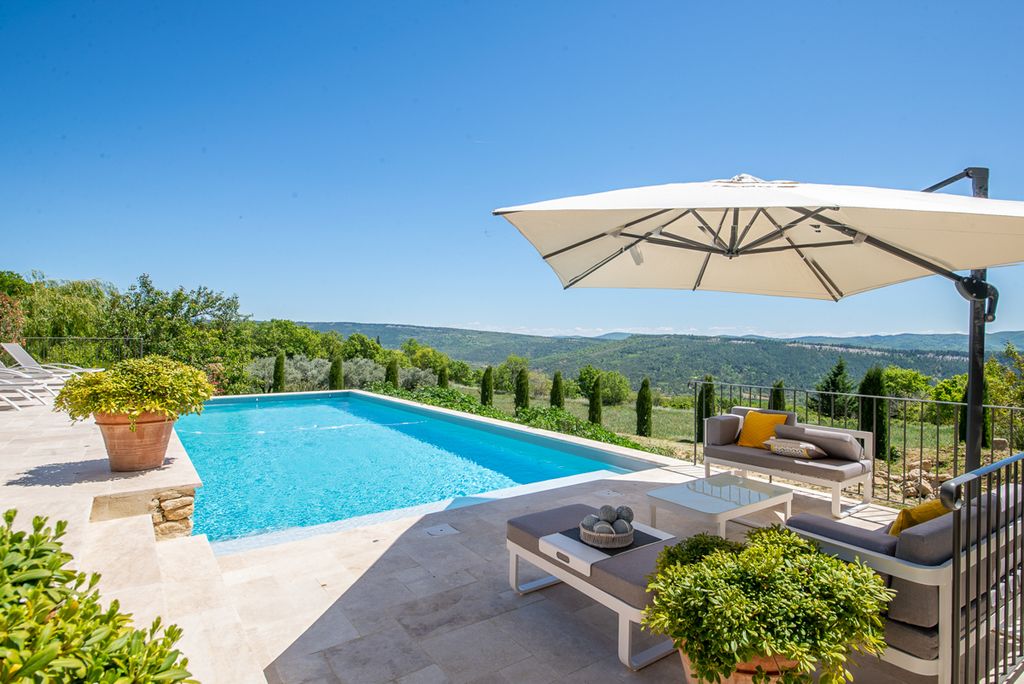
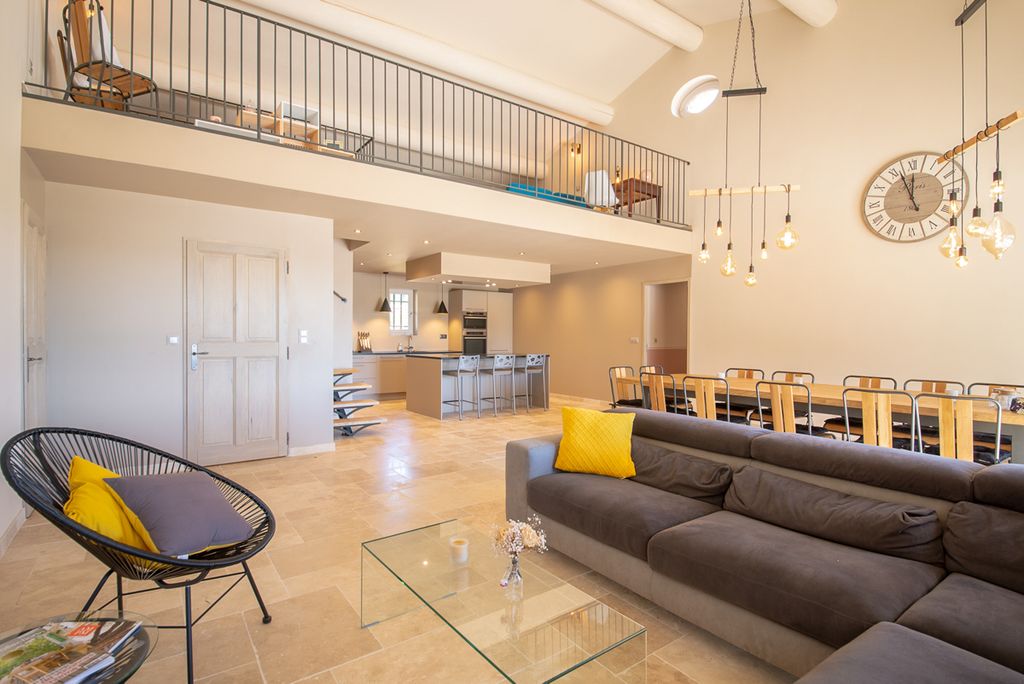
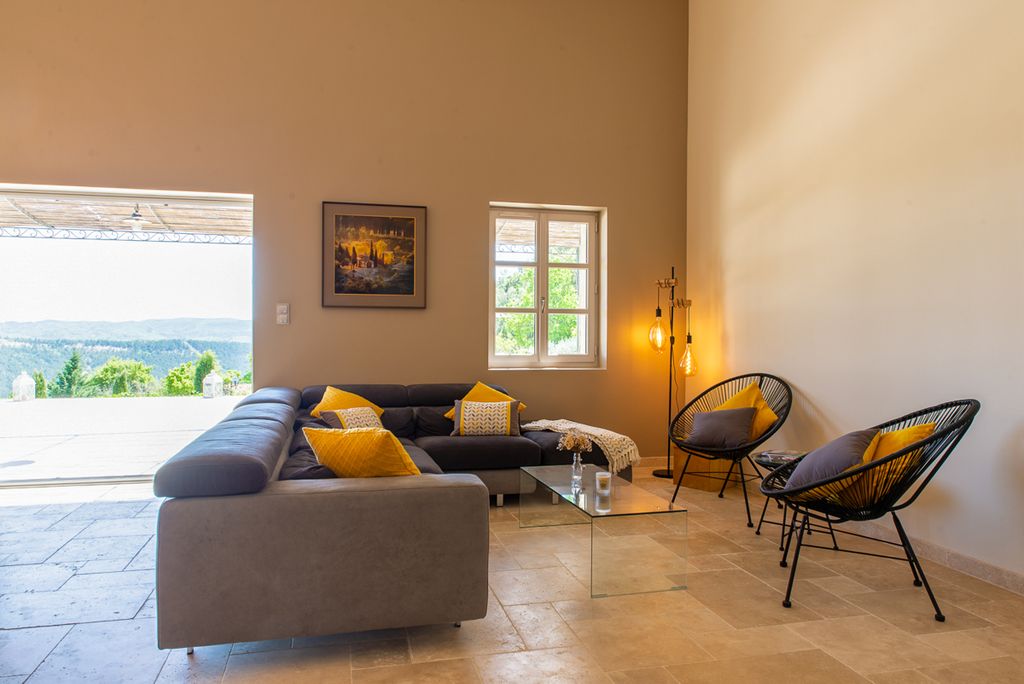
Maison Bras is located on a hillside just below the charming village of Viens and both the house and village enjoy sensational views across the countryside. The old village ramparts are still dotted with square and round towers, the ancient Saracen tower now acting as a door. Viens’ narrow cobbled streets lead you to the old 16th century Renaissance castle built on the foundations of the 12th century fortress. The village is sprinkled with noble dwellings including the Monier d’Arnard house and the Monier de La Quarre house. The town hall is housed in the old hotel of Pontevès dating back to the 16th century. An 11th century tower adjoins the site. The village Romanesque parish church of Saint Hilaire was built in the 12th century and then remodelled in the 17th century. There are old wash houses, a fountain, an ancient bread oven and a 16th century oil mill as well as lovely walks and opportunities for horse back riding or mountain biking.
Not far away from here, Roussillon with its magnificent cliffs stands proud in all different shades of ochre. If you walk up to the Castrum at the top, you will enjoy fabulous vistas across the valley to the Grand Luberon, the slopes of Mont Ventoux and the Vaucluse plateau. The quarry is the starting point of a wonderful 15km walk to the Colorado de Rustel quarry which offers a similar landscape and the fields on the approach to Roussillon are also a reddish orange hue due to the natural pigment of its ochre quarry. The main square of Roussillon is home to an excellent ice cream shop and a number of wonderful restaurants on the square. Roussillon boasts an interesting history and featured in the book ‘A Village in the Vaucluse’ by Laurence Wylie in 1957 when it was a very rural village which was referred to as Peyranne.
The characterful French village of Gordes is another Provençal treat. Gordes boasts pretty narrow alleyways lined with charming restaurants and cafes as well as an outstanding bakery and food stores. On the Luberon plain, the village enjoys superb views. Gordes is dominated by its wonderful church and castle. During World War II Gordes was mostly destroyed and the villagers massacred. The whole village was awarded the Croix de Guerre medal.
Gordes’ Tuesday morning market is a perfect place to pick up local produce and a few souvenirs. In the basement of Gordes, you can make a magical underground discovery looking at the treasure of the Caves du Palais Saint Firmin, just a five minute walk from the castle. The cellars would have been used in the Middle Ages to house craft activities and it is still possible to see an old oil mill, cisterns and pipes dug into the rock. A small underground city can be explored with its carved pillars, stone staircases and beautiful vaulted ceilings.
You should also try and fit in a trip to L’Isle-sur-la-Sorgue, a characterful market town that enjoys a brilliant array of restaurants, cafes, bars, boutiques, shops, antique centres, galleries and a fabulous historic centre. It is commonly referred to as ‘The Venice of Provence’ for its numerous canals but is also known as the ‘antiques capital of France’. Hundreds of stores and stalls are open every Sunday selling collectable bric-a-brac and serious antiques. The town also hosts an International Antiques Fair twice a year, at Easter and in August. Sitting on the Sorgue River there are many waterside restaurants and cafes and in August there is also a lovely floating market in addition to the usual Sunday morning market.
The Region
With some of the most enchanting landscapes of Provence, the Luberon awaits with its idyllic perched villages, swathes of lavender, cherry trees, vineyards and dense forest.
Become captivated by the scenery as you potter around artistic Gordes with its atmospheric Tuesday morning market before heading to hilltop Ménerbes, the village that inspired Peter Mayle’s ‘A Year in Provence’. Romantic Bonnieux enjoys the most glorious vistas, surrounded by a sea of vines and orchards, whilst red-hued Roussillon will take your breath away with its ochre landscapes and pine forests. They are all officially classified as ‘Plus Beaux Villages’ in France.
Yet there are so many hidden gems to explore as well. Discover the historic doorways, windmills and summer cherries of Saint-Saturnin-lès-Apt, then head to Goult to embrace its Provençal charm with little shops and pavement cafes. Surrounded by fields of lavender, Saint-Saturnin-lès-Apt is another historic jewel of the Luberon, often overshadowed by the handsome and historic town of Apt.
To the south of the Luberon, follow Albert Camus’ footsteps in Lourmarin, sip coffee by the picturesque bassin lined with plane trees in Cucuron and soak up the history of Ansouis – all three villages have a fine reputation for their high-end dining with a choice of Michelin starred restaurants.
Indeed, across the region look out for restaurant terraces serving Provençal cuisine with superb vistas alongside characterful markets showcasing seasonal delights from the Luberon and beyond (olives, melons, strawberries, cherries, truffles, chestnuts, lavender products and more). Most villages host a lovely weekly market whilst the largest in the Luberon is held on a Saturday morning in Apt. Just on the edge of the Luberon, L'Isle-sur-la-Sorgue is famed for its antique stores and Sunday morning brocante. Meanwhile, wine lovers should visit the vineyards and wineries of the region producing Luberon and Ventoux AOC wines.
The walking, hiking and cycling opportunities in the Luberon seem endless and you will also find horse-riding, rock-climbing and tree-top adventures as well as canoeing and kayaking along the Sorgue near Fontaine-de-Vaucluse. Come across hiking trails for all abilities passing vineyards and forest or venture through the hills and mountain gorges for spectacular scenery. Cycling is also extremely popular – as well as more challenging routes, we especially love the family-friendly Véloroute du Calavon, a paved voie verte following a former railway line near the Calavon river passing poppies, lavender and orchards so typical of the Luberon.